Feral Pigeons
The tragic abandonment of a once beloved bird
Before we called pigeons filthy flying vermin, they were something far different for us. They were animals that we bred for food, for communication, and even for beauty. They were our domesticated companions and livestock.

Cher Ami
The Pigeon who saved the French soliders of the 77th Infantry
In 1918, during the First World War, a French military pigeon called Cher Ami was the first to be publicly honored for its war effort. In October of that year, the 77th Infantry Division was cut off and surrounded by German troops. Unable to break out, the commander made repeated attempts to appraise his headquarters of the situation, but every messenger bird he sent was either wounded or killed. Cher Ami was the last messenger remaining bird he had. Although also wounded twice, once in the chest and once in the leg, which was almost shot off and carried the message tube, the valiant bird delivered the message.
A rescue mission was mounted and the soldiers of the 77th were saved from being either captured or killed. The authorities recognized Cher Ami’s bravery by awarding her the French Croix de Guerre with Palm, which honors heroic service.
We bred pigeons to be comfortable in the company of humans, and now we hate them as they dare to live beside us. Their plight begs the question:
What should be done with domesticated animal species that society no longer has use for?

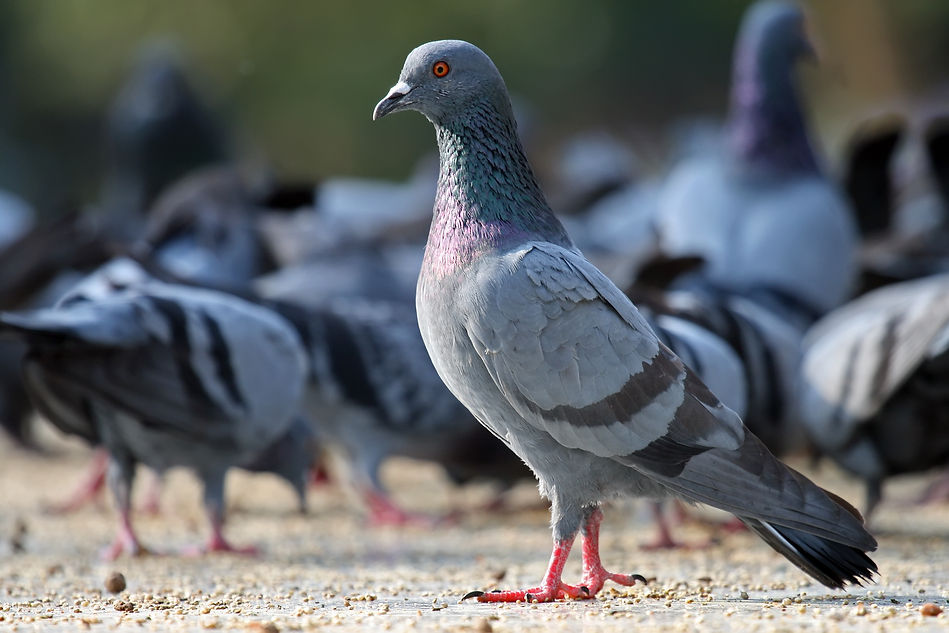
pi·geon
/ˈpij(ə)n/
noun
-
1.
a stout seed- or fruit-eating bird with a small head, short legs, and a cooing voice, typically having gray and white plumage.
“Pigeon” is actually a very imprecise way to refer to these birds. The word “pigeon,” like “goose,” is a name that describes an entire range of animals. Pigeons and doves are members of the Columbidae family of birds, a group that includes over 300 species. So while we might call the bird we see on the streets a pigeon, it’s important to remember that there are also wood pigeons, imperial pigeons, laurel pigeons, and a myriad of others that share the name.
Not only is it vague to call our feathered urban neighbors pigeons, it isn’t even technically accurate. The scientific name for these birds is Columba livia. Formally, they are known as rock doves. Doves and pigeons are very similar, though doves usually have bigger tails and smaller bodies. Columba livia better matches the description of a dove than a pigeon, but it seems unlikely that the “pigeon” moniker will go away anytime soon.

Pigeons are not native to the streets of New York City or to North America at all.
The native range of Columba livia falls across Northern Africa,
Southern Europe, the Middle East, and Western Asia.

Domestication of the Pigeon

It may be astonishing to us now, but the pigeon was once a vital part of human culture and society. It is unclear when rock doves were domesticated, but they first appear in written history on Mesopotamian cuneiform tablets from over 5,000 years ago. Some estimates put pigeon domestication closer to 10,000 years ago. Given the fragility of bird bones and their poor preservation in the fossil and archeological record, it may be some time before we can narrow down the date any further.
Pigeons were originally farmed as a food source. Chicken and geese were domesticated earlier, but pigeons were the dominant meat bird in the Middle East and Europe for thousands of years. Pigeons made for good eating and the unerring ability of a pigeon to find its way home gave rise to another valuable use: Homing pigeons.


It’s easy to take communication for granted in the days of telephones and the internet, but carrier pigeons were the cutting-edge technology of the past. As early as 3,000 years ago, people were sending messages attached to pigeons. They were sent between cities in ancient Rome to announce winners of the Olympics and the results of chariot race bets. Genghis Khan had a system of pigeon relays that spanned from Asia to Eastern Europe and allowed him to keep in contact with even the far reaches of his empire.
Think pigeon mail is a thing of our distant past? They were still in use as recently as WWII, when the United Kingdom used somewhere in the vicinity of 250,000 homing pigeons to carry messages behind enemy lines and through battle zones. It was only in 1948 that the UK military discontinued their use of the helpful birds.


Beyond food and communication, domesticated pigeons have served several other purposes. Some were bred simply for beauty. There are around 800 breeds of fancy pigeon in the modern day and people have been breeding for pretty pigeons since before 950 BC, when the Greek poet Homer referred to “Messene’s towers for silver doves renowned” in his writings.
Pigeons have also been bred for sport throughout their long history. Pigeon contests have included matches of speed, agility, or acrobatics, and some breeds are known for their ability to perform impressive rolls, twists, and dives.


Feral pigeons are essentially the same size and shape as the original wild rock dove, but often display far greater variation in color and pattern compared to their wild ancestors.

Wild Rock Dove
Feral Pigeon


FERAL
are
PIGEONS
How domestication and colonization uprooted the birds
As mentioned previously, we brought the pigeon to America. More specifically, colonists in the 1600s did. They were originally imported as barnyard animals and farmed for food. It can be rather difficult to contain a flying animal, and many pigeons meandered away from their keeps and set off on their own in the New World. They thrived in the altered habitats of human towns and cities, and soon established themselves as permanent residents in the local ecosystem, making them one of the earliest invasive species in the Americas.
Though we might call pigeons wild animals, a better way to describe them would be feral. A wild animal is one that evolved naturally. Feral animals are creatures we domesticated, but that have escaped and now live and breed on their own.
Their feral nature is visible in the variety of colors they sport. Wild rock doves are only found in the common gray-black color scheme. Feral pigeons can share the color of their wild ancestors, but they also come in shades of red, brown, or white, with a variety of fascinating patterns as well. The next time that you see a brown or a white pigeon, know that it is only that color because at some point in our history we found white or brown pigeons beautiful.
Feral pigeons are so successful that they have even begun encroaching on wild rock dove populations. Where populations mingle, interbreeding is bound to occur. Wild rock doves have interbred so much with their feral cousin that in time there may be no truly wild rock doves left. In a few hundred years, all we have left of this species may be the descendants of our domesticated farm animals.
A Friendship Diminished
The pigeon was once held in high regard. Because of our close partnership with the species, people were able to learn a lot about the habits and life cycle of the pigeon. They found that pigeons were monogamous and often mated for life. Both parents care for offspring, and though they are peaceful and intelligent, they protect their nest fiercely. These pigeon behaviors are also esteemed human behaviors, and the pigeon was brought into this esteem as well.
Pigeons and doves figure prominently in many religions, like the dove of Noah’s ark. In China, pigeons and doves represent longevity and fidelity. Pigeons used to be valued medicinally as well, and it was believed that their meat could cure diseases like plagues and palsies. Our appreciation of pigeons in the past is a far cry from the loathing they receive today. How did the pigeon fall so far from grace? It’s all a matter of perspective.

The early 20th century was a time of great change for the United States. One of these changes was in opinion about the sparrow. They went from hated to tolerated, and eventually attained the fairly indifferent status they enjoy today. However, as opposition to sparrows grew less fierce, the pigeon began to rise as the new so-called “filthy bird.”
The term “rats with wings” is widely attributed to the 1980 film Stardust Memories, but it actually first appeared in print in 1966 in a quote by the New York City Parks Commissioner. However, it wasn’t until the film brought the term into public awareness that “rats with wings” really took off. Now, it can be said that the image of the winged rat truly defines the popular perception of pigeons as flying filthy vermin.
Sadly, much of the pigeon’s bad reputation is based on misconception. In truth, it is exceedingly uncommon that pigeons are harmful to human health. There is a very minor risk of contracting an illness after contact with pigeon droppings, but disease transmission from pigeon droppings is vanishingly rare. There is almost no threat of catching something from pigeon poop unless you have an impaired immune system or come into excessive contact with the droppings (cleaning them off your windowsill doesn’t count as “excessive contact”). Pigeons can catch diseases like West Nile Virus and bird flu but they don’t appear to spread them to other birds, meaning they aren’t dangerous to the health of other birds either.
In many ways, the fate of the rock dove is very sad. We relied on and cherished the domesticated pigeon for thousands of years, and they certainly would not be crowding city streets in the United States if we didn’t bring them there in the first place.